Simply having a website is no longer enough to attract customers online. Every day, millions of users search for products, services, and information on search engines like Google. If your website doesn’t appear in relevant search results, potential customers are likely to choose your competitors instead.
This is where a well-planned Search Engine Optimization (SEO) strategy becomes essential. Rather than relying on guesswork or isolated marketing efforts, an SEO strategy provides a structured roadmap to improve your website’s visibility, attract qualified visitors, and convert them into loyal customers.
Modern SEO goes beyond ranking for keywords. It includes creating high-quality content, optimizing technical performance, improving user experience, earning trust through authoritative backlinks, and preparing your website for AI-powered search experiences. A comprehensive SEO strategy ensures your business remains visible across traditional search engines and emerging generative search platforms.
Key Takeaways
- An SEO strategy helps your website attract consistent organic traffic without relying solely on paid advertising.
- Well-planned SEO improves search rankings, user experience, and online credibility, making it easier for customers to find and trust your business.
- A modern SEO strategy includes content, technical optimization, local SEO, and link building rather than focusing only on keywords.
- SEO supports AEO (Answer Engine Optimization) and GEO (Generative Engine Optimization) by creating content that answers user questions and aligns with AI-powered search.
- Businesses that invest in long-term SEO are better positioned for sustainable growth, qualified leads, and higher ROI.
Why Is an SEO Strategy Important?
An SEO strategy is a long-term plan designed to improve your website’s visibility in search engine results for keywords and topics relevant to your business. Rather than making random website changes, an SEO strategy aligns your content, technical optimization, user experience, and authority-building efforts toward measurable business goals.
An SEO strategy provides direction and consistency. Without one, businesses often publish content or make website changes without understanding whether those efforts support their goals.
Benefits of Having an SEO Strategy
- Increases website visibility
- Generates high-quality organic traffic
- Builds long-term brand authority
- Improves customer trust
- Reduces dependence on paid advertising
- Supports lead generation
- Enhances user experience
- Delivers measurable, long-term results
An organized strategy ensures that every optimization contributes to your overall digital marketing objectives.
Improve Your Search Engine Visibility: Search engines aim to deliver the most relevant and useful results for every query. A strong SEO strategy helps your website appear for searches related to your products, your services, industry topics, customer questions, and local searches. Higher visibility means more opportunities to attract potential customers who are actively looking for what you offer.
Drive High-Quality Organic Traffic: Organic traffic comes from users who find your website naturally through search engines. Unlike paid advertisements, organic traffic can continue generating leads over time without requiring ongoing advertising costs. Visitors from search engines often have higher intent because they are already searching for a solution to their problem. This leads to better engagement, longer session duration, higher conversion rates, and lower customer acquisition costs.
Build Trust and Credibility: People naturally trust websites that appear prominently in search results. An effective SEO strategy strengthens your credibility by focusing on helpful content, accurate information, secure browsing (HTTPS), fast page loading, positive user experience, customer reviews, and authoritative backlinks. Trust is an important factor in encouraging visitors to become customers.
Improve User Experience (UX): SEO and user experience go hand in hand. Google rewards websites that offer a positive browsing experience. Your strategy should prioritize mobile-friendly design, fast loading speeds, clear navigation, accessible content, readable formatting, internal linking, and easy-to-find contact information. A better user experience benefits both search rankings and customer satisfaction.
Support Long-Term Business Growth: Unlike short-term campaigns, SEO compounds over time. Every optimized page, blog article, and backlink strengthens your website’s authority. Long-term SEO contributes to consistent lead generation, improved brand recognition, higher customer retention, sustainable marketing performance, and increased return on investment. Businesses that invest in SEO today continue benefiting from those efforts for months and even years.
Core Components of an Effective SEO Strategy
A successful SEO strategy includes several interconnected elements.
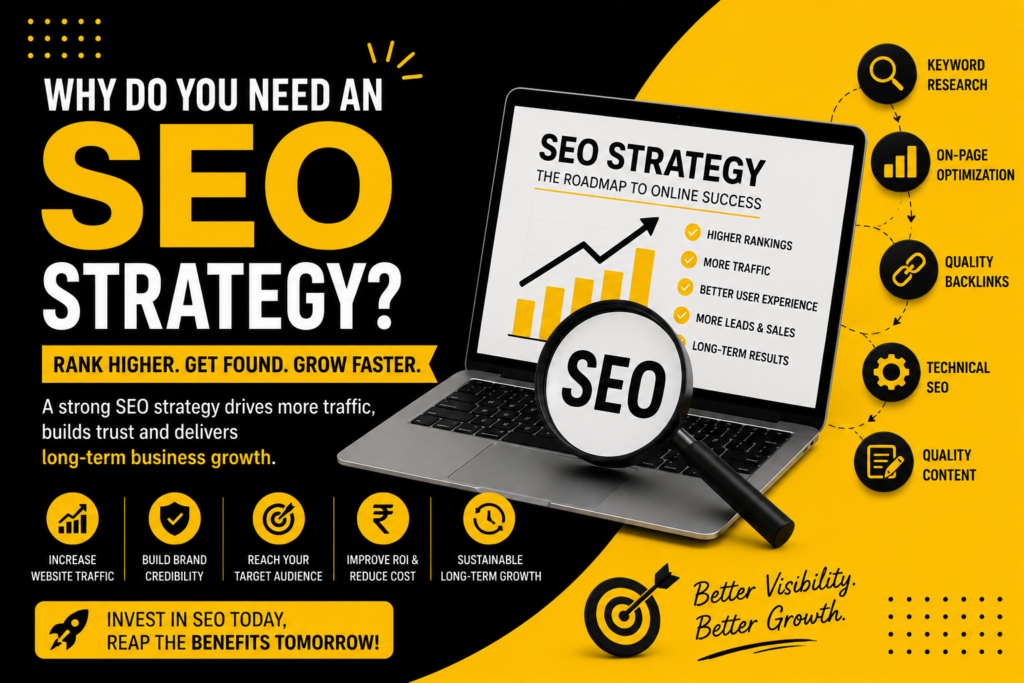
- Keyword Research: Identify the search terms your audience uses and prioritize keywords based on relevance, intent, and competition.
- High-Quality Content: Create original, accurate, and helpful content that answers user questions and demonstrates expertise.
- On-Page SEO: Optimize title tags, meta descriptions, headings, URLs, images, internal links, and structured formatting.
- Technical SEO: Ensure your website is fast, secure, mobile-friendly, crawlable, indexable, and free of technical errors.
- Link Building: Earn quality backlinks from reputable websites to improve authority and trust. Focus on natural link acquisition through valuable content and partnerships.
- Local SEO: Optimize your online presence to attract customers within your service area through local listings, reviews, and location-specific content.
How SEO Supports AEO & GEO
Search behavior is changing rapidly as users increasingly rely on AI-powered assistants and conversational search.
SEO Supports AEO by providing direct answers to common questions, using clear headings and structured content, including FAQ sections., organizing information for featured snippets, and improving readability and accessibility.
SEO supports GEO by Generative Engine Optimization (GEO) helps your content become more useful for AI-generated search results. Effective GEO practices include demonstrating expertise and experience, publishing comprehensive, trustworthy content, using semantic keywords and related topics, updating content regularly, including examples, statistics, and practical insights, and structuring content logically for AI interpretation. By combining SEO with AEO and GEO, businesses can improve visibility across traditional search engines and AI-driven discovery platforms.
Common SEO Strategy Mistakes to Avoid
Many businesses fail to achieve results because they overlook essential SEO practices. Avoid these common mistakes:
- Targeting irrelevant keywords
- Publishing thin or duplicate content
- Ignoring technical SEO issues
- Neglecting mobile optimization
- Failing to update older content
- Overusing keywords (keyword stuffing)
- Ignoring search intent
- Building low-quality backlinks
- Tracking rankings without measuring conversions
An effective SEO strategy focuses on delivering value to users while meeting search engine quality standards.
Frequently Asked Questions (FAQs)
Q1. What is an SEO strategy?
A: An SEO strategy is a structured plan that improves a website’s visibility in search engines through keyword research, content creation, technical optimization, user experience improvements, and authority-building activities.
Q2. Why is an SEO strategy important?
A: An SEO strategy helps businesses attract organic traffic, improve search rankings, generate qualified leads, enhance user experience, and achieve sustainable long-term growth without relying entirely on paid advertising.
Q3. How long does an SEO strategy take to show results?
A: SEO is a long-term investment. While minor improvements may appear within a few weeks, meaningful results typically take three to six months, depending on your industry, competition, and the quality of your optimization efforts.
Q4. Can small businesses benefit from an SEO strategy?
A: Yes. A well-executed SEO strategy helps small businesses compete with larger brands by targeting niche keywords, optimizing for local searches, and creating valuable content that addresses customer needs.
Q5. How often should an SEO strategy be updated?
A: Your SEO strategy should be reviewed regularly—at least every quarter—to account for algorithm updates, changing customer behavior, new competitors, and evolving business objectives. Continuous optimization is key to maintaining strong search performance.
An SEO strategy is not just about achieving higher rankings—it is about creating a sustainable framework for attracting, engaging, and converting the right audience. By aligning keyword research, technical optimization, valuable content, user experience, and authority-building efforts, businesses can establish a strong online presence that continues to deliver results over time.
As search engines become more intelligent and AI-powered search experiences continue to evolve, businesses need strategies that prioritize relevance, trust, and user intent. Investing in a comprehensive SEO strategy today positions your website for greater visibility, stronger customer relationships, and long-term digital growth in an increasingly competitive online landscape.